- Home
-
Company Profile
- About Us
- About Our Export
- What We Do
- Precision Machining Capabilities & Manufacturing Process
- Products We Manufacture: Precision Components & Work Holding Solutions
- Custom Manufacturing & OEM Engineering Solutions
- Industries We Serve
- Quality Assurance, Certifications & Standards
- Infrastructure, Technology & Manufacturing Facilities
- Our Products
- Blogs
- Contact Us

Collets

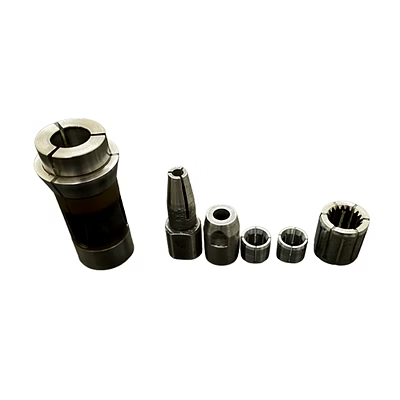
Special purpose Collet
special purpose collet for tooling
Special purpose collets are configured for non-standard tool profiles or delicate workpiece geometries. These collets focus on tailored gripping faces, reduced contact pressure, or modified taper geometries to protect thin-walled parts during machining. The design is selected where off-the-shelf collets do not satisfy fit or handling constraints.
Procurement teams deploy special purpose collets for fixtures, low-distortion machining, and sub-assembly operations where part integrity is essential. Specification steps include confirming tool-holder interfaces and supplying sample parts or CAD geometry for evaluation. Inspection checkpoints are recommended before production release.
Commercial options include wholesale order bands for production runs and batch inspection traceability. Packaging and handling are arranged to preserve contact surfaces. This collet type is suited to OEM buyers, maintenance planners, and project procurement teams that require bespoke gripping behavior.
Price upon request

Collet
precision collet manufacturer for assembly
Precision collets are engineered to secure cutting tools and workpieces for machining and assembly operations. This collet variant emphasizes consistent clamping force and concentricity to reduce runout during high-speed turning and milling. Procurement teams and OEM assembly planners use these parts when repeatability and interchangeability across lot runs are required.
The product supports scalable production workflows and routine inspection. Sample validation and dimensional checks can be incorporated into production planning to confirm fit and grip performance. Typical buyer concerns include compatibility with existing spindles, tooling interface, and batch inspection records.
When selected for production, collets offer compact geometry and straightforward replacement procedures on shop-floor tooling. They suit maintenance buyers, procurement teams managing rotation stocks, and OEM supply chains needing consistent part fit. Commercial terms can be arranged for volume orders and scheduled replenishment cycles.
Price upon request

Special Collet
Special Collet
This special collet is a custom workholding component designed for non-standard shafts and unique assembly interfaces. It supports applications that require bespoke internal profiles, modified clamping ranges, or specialized finishes. Buyers include tooling designers, OEM production planners, and contract manufacturing partners who require drawing-based, repeatable clamping solutions.
Production supports custom profiles and tight tolerances with inspection checkpoints to validate fit and concentricity. Prototype runs and volume production scaling are part of the available supply options.
Price upon request

Collet Chuck
Collet Chuck
The collet chuck is a precision workholding device used in spindles and machine tool setups to secure tools or workpieces with controlled concentricity. It is specified by tooling engineers, CNC shops, and OEM production planners who require stable clamping, low runout, and repeatable changeover. Manufacturing focuses on concentric bore quality and durable finishes suited to machining environments.
Production includes turning, milling, and finish machining with inspection points to confirm runout and clamping geometry. Supply options include prototype quantities and volume runs with inspection documentation for procurement acceptance.
Price upon request
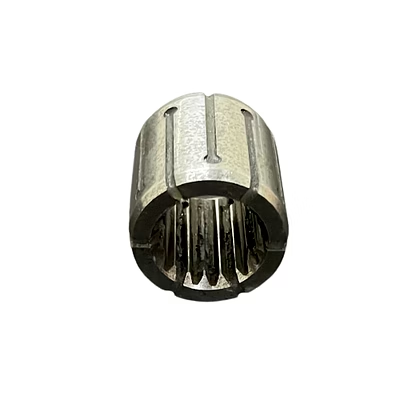
Spline Collet
Spline Collet
The spline collet is a precision workholding component designed to clamp splined shafts and assemblies with controlled concentricity. It is used in machining, assembly fixturing, and rotating equipment where accurate torque transfer and low runout are required. Typical buyers include tooling engineers, OEM assembly planners, and maintenance teams for rotating machinery.
Production uses precision turning and internal feature machining to maintain clamping geometry and concentricity. CMM inspection and batch traceability are available for qualification and procurement acceptance.
Price upon request
Interface standards and repeatability
ER Collets Manufacturer focuses on interface repeatability and spindle compatibility; buyers select collet families by ER size to match tooling and taper standards.
- ER sizes map to standard chuck and spindle tapers for interchange
- Selection prioritizes consistent clamping and minimal runout across cycles
Clamping performance and runout control
Clamping stability is the dominant selection factor; jaw profile and finish determine holding force and axial runout performance.
- Jaw contact geometry affects gripping range and concentricity
- Surface finish impacts micro-slip under torque
Changeover efficiency and maintenance planning
Changeover speed and predictable jaw wear reduce downtime; specify service intervals and replacement part references in procurement documents.
- Standardized sizes simplify tooling swaps
- Plan spare jaw sets to minimize production interruption
Ordering and OEM compatibility
Include interface drawings and desired surface treatment with RFQs to confirm fit and finishing expectations; OEM engineering options support minor interface adjustments.
Faqs
Q: What are typical MOQs for ER collet orders?
A: MOQ varies by size and finish; provide the size list and required annual volumes to receive volume-tier proposals.
Q: How is pricing affected by collet size and finish?
A: Larger diameters and specialty coatings increase cost; pricing is quoted per size band and batch quantity.
Q: Are material and inspection certificates available for collets?
A: Request material certificates and inspection reports at RFQ stage to confirm metallurgical traceability.
Q: What is the typical lead time for production runs of ER collets?
A: Lead time depends on size mix and heat-treatment steps; include delivery windows when requesting quotes.