- Home
-
Company Profile
- About Us
- About Our Export
- What We Do
- Precision Machining Capabilities & Manufacturing Process
- Products We Manufacture: Precision Components & Work Holding Solutions
- Custom Manufacturing & OEM Engineering Solutions
- Industries We Serve
- Quality Assurance, Certifications & Standards
- Infrastructure, Technology & Manufacturing Facilities
- Our Products
- Blogs
- Contact Us

Work Holding Components

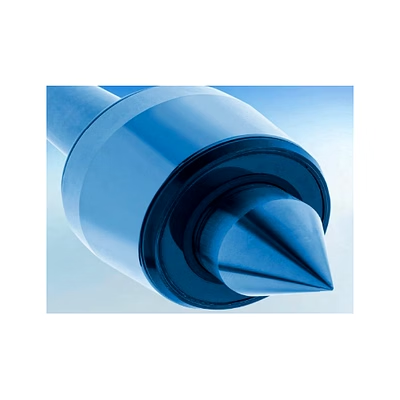
Centre
Live Centre for Lathe Turning Applications
This live centre is engineered to support rotating workpieces with low runout and stable axial support during turning. It suits production turning, finishing operations, and OEM assembly where accurate concentricity and bearing performance matter. The design emphasizes robust bearing life and secure tool interface to maintain geometric stability under radial and axial loads.
Buyers evaluate bearing class, taper interface and lubrication regime when selecting centres for high-volume production. Commercial support includes wholesale sourcing and scalable production with inspection documentation to assist procurement and maintenance planners.
Price upon request
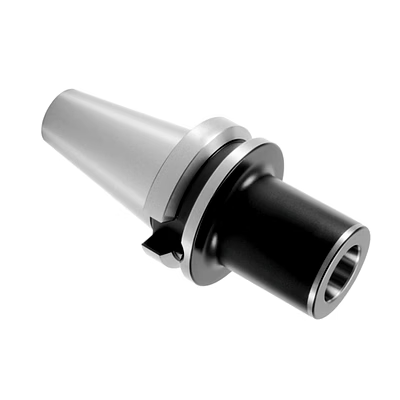
CNC Morse Taper Holder
CNC Morse Taper Holder for Tooling Integration
Designed for precision spindle-to-tool interfacing, this CNC Morse taper holder supports machine-tool setups that require accurate axial alignment and repeatable concentricity. It is suited to machining centers, toolrooms, and OEM assembly lines where taper fit and runout control are key selection criteria. The holder maintains consistent taper seating and resists micro-movement during turning and drilling operations.
Technical selection emphasizes taper compatibility and fit tolerance. Buyers typically evaluate taper size, clamping method and inspection reports when qualifying parts for production. Commercially, this SKU supports bulk sourcing and scalable production runs with batch inspection documentation available to procurement teams and OEM buyers.
Price upon request
Clamping repeatability and jaw protection
Work Holding Components Supplier pages prioritize clamping repeatability and jaw-contact design to minimize part damage and maintain positional accuracy.
- Jaw material and profile choices affect grip and surface marking
- Soft-jaw options protect delicate parts while hardened jaws suit heavy-duty clamping
Setup stability and interface standards
Mounting patterns and modular bases are primary selection points to ensure fixture compatibility and fast setup.
- Specify mounting datum and bolt patterns for direct interchange
- Modular interfaces reduce rework when updating fixtures
Component variants and use-case groups
Components are grouped by application: production vices, adjustable clamps and modular elements for automation or manual workstations.
- Production vices tailored for throughput and repeatability
- Clamps and stop blocks for secondary operations and fixturing
Procurement and packaging options
Provide part lists, annual usage and spare-part needs in RFQs to align MOQ, packaging and spare provisioning with production planning.
Faqs
Q: What are the minimum order quantities for work holding components?
A: MOQ varies by component family and finish; include part lists and forecasted usage to receive structured MOQ proposals.
Q: How are work holding components priced for bulk orders?
A: Pricing reflects material, heat treatment and complexity; bulk pricing steps are provided per ordered bands.
Q: Which inspection or material certificates can be requested?
A: Request material certificates and inspection summaries at RFQ stage to confirm compliance with procurement requirements.
Q: How are work holding components packaged and shipped for production runs?
A: Packaging is arranged by component type and protection needs; palletization and documentation options are set during order confirmation.